What Is an Index, and Why Does It Matter?
The Nifty 50, the Sensex, and how an index is actually built — the groundwork for trading index options.
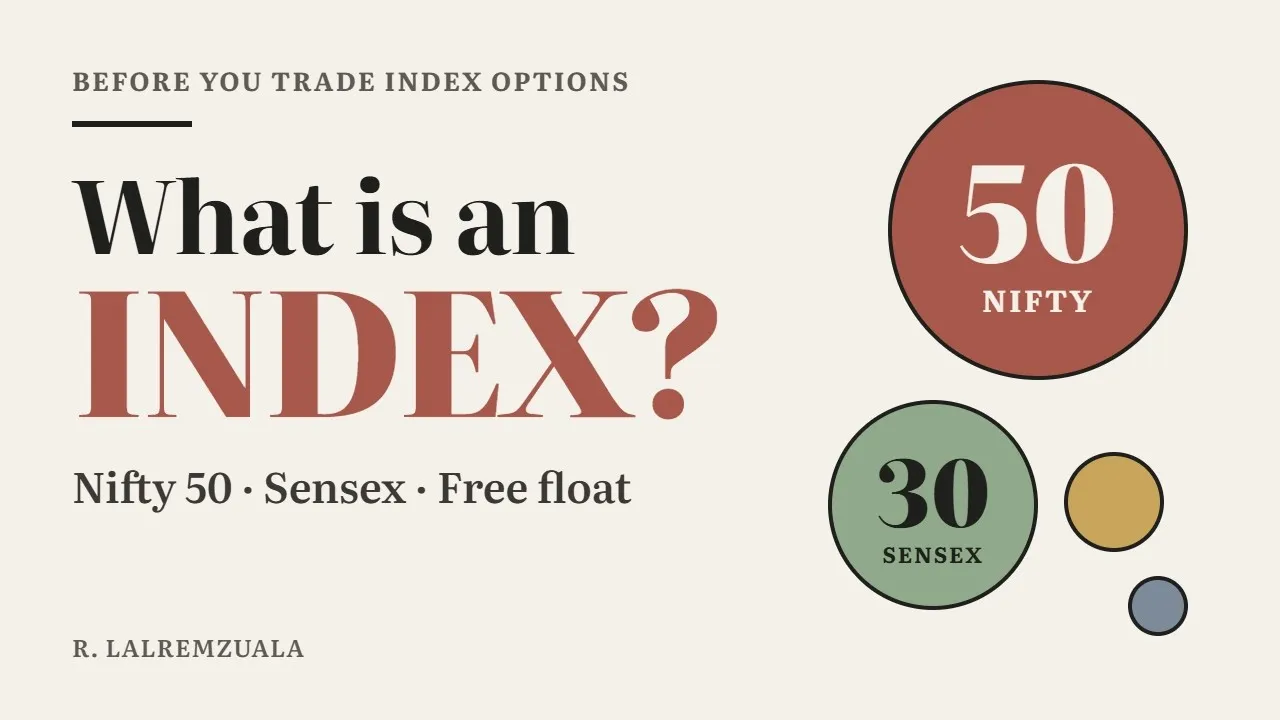 Watch the video: What Is an Index, and Why Does It Matter?
In the previous article we talked about what derivatives really are. We understood that a derivative is a product derived from an underlying, and that the underlying could be any asset. It could be an index as well.
So today we must understand what an index is. It’s important because we will be talking about how to trade index derivatives, especially index options.
So what is an index?
The word itself simply means an indicator. An index is a statistical indicator that measures changes in the economy in general. In the financial market, an index of stocks represents a particular market, or a portion of a market, and inside that index there are stocks.
Each index has its own method of calculation, and it is expressed as a change from a base value. The base value could be as recent as the previous day, or many years in the past. And when we talk about the changes, it’s much easier to represent them in percentages.
Indices can be created to measure and track the price movements of bonds, T-bills, stocks and other types of financial securities. In our case, a stock index is created to give market participants information about the average movement of share prices. When we look at a stock market index, we are looking at the price performance of a specific group of stocks — the index acting as a barometer for the overall market, or for a specific sector.
The indices worth knowing
In India, we have two key indices. Globally, there are two more worth noting.
- Nifty 50: The 50 largest and most liquid stocks on the National Stock Exchange (NSE).
- BSE Sensex: 30 well-established companies on the Bombay Stock Exchange (BSE).
- S&P 500: 500 of the largest public companies in the United States.
- FTSE 100: The 100 largest companies listed on the London Stock Exchange.
Why an index matters
It’s a barometer
A stock index measures the performance of the overall market, or of a particular sector. If we say the Nifty 50 is up by 1%, it means the 50 largest companies on the NSE are up 1% in overall performance. And if the auto sector index has been bullish this month, it simply means the auto stocks that make up that index have been going up. You can check the constituents of each index on NSEIndia.com.
It’s a benchmark
An index serves as a benchmark for portfolio performance. For example, I run a systematic investment portfolio personally, and my benchmark is the Nifty 500, because I trade and invest in the constituents of the Nifty 500. Portfolios that belong to individuals, mutual funds or hedge funds all use stock indices as a measure for evaluating their performance.
It’s an underlying
An index is used as the underlying for financial derivatives. In my other articles and videos, you’ll see that I trade Nifty options a lot. The Nifty 50 is the underlying for the derivative I trade, which is options. Various products, in both OTC and exchange-traded markets, are based on indices as their underlying asset.
How an index is built
If you want to truly advance as an index trader, it’s very important to understand how an index is constructed in the first place. Like we said, an index is a composition of many stocks or securities, and together they represent the state of the economy.
Indian stock exchanges follow a method called free-float market capitalisation. In this method, weights are assigned based on a company’s free-float market capitalisation. It simply means: the higher the market capitalisation, the higher the weight of that stock in the index.
So what is free float?
You must be wondering what free float means. In any business, equity ownership is divided among different stakeholders. There are promoters, institutions that own parts of companies, corporates, individuals and other participants. The market started to separate this on the basis of what is readily available for trading and what is not.
The portion available for immediate trading is categorised as free float. When an index is computed on that basis, the process is called a free-float market-capitalisation index. The free-float market capitalisation is calculated by multiplying the number of free-float shares — the shares readily available for trading — by the stock price.
There are other methods of designing an index, like the price-weighted index and the equal-weighted index. I won’t go into detail on these. Just know they exist, and if you’re interested, research them further. Since our main indices in India use the free-float market-capitalisation method, that’s the one I’ll focus on.
What indices are used for
Indices were created as a way to measure the overall direction of the stock market. In terms of application, they show up in three main places.
Index funds
An index fund is a type of investment in a specific index. The main objective of the fund is to generate returns as close as possible to the index itself. For example, a Nifty index fund would get similar returns to the Nifty 50. And since the Nifty 50 has 50 shares, the fund also invests in those 50 companies, in the same proportion in which they exist in the index.
Index derivatives
Index derivatives are simply derivative contracts that have the index as the underlying asset — like Nifty options, the one I trade the most. Index options and futures are the most popular derivative contracts, not only here in India but worldwide. As for my own use, I use index options as a tool to hedge against market risk.
Exchange-traded funds (ETFs)
ETFs are baskets of securities that can be traded like an individual stock on the exchange. If you go to your broker’s platform and type something like Nifty BeES, which is the Nifty 50 ETF, you can trade it like any individual stock.
Why ETFs are gaining popularity
ETFs have a few advantages over index funds and mutual funds. They can be bought and sold on the exchange quite easily, which means they can be traded intraday as well. Another advantage is low cost — a lower transaction cost, or expense ratio.
December 2001 was when Nifty BeES, the ETF I mentioned, was introduced — the first ETF in India.
ETFs have been gaining a lot of popularity lately. They’re easy to trade, low cost, and you can create a portfolio of ETFs easily.
Summing up
- An index acts as a barometer of a country’s whole economy.
- An index going up indicates that market participants are optimistic; an index going down indicates they are not.
- India has two main indices: the Nifty 50 from the NSE and the Sensex from the BSE.
- India follows the free-float market-capitalisation method to construct its indices.
- There are also sector-specific indices, which tell us the sentiment of specific sectors.
Referral link. *The brokerage will not exceed the SEBI prescribed limit. Investment in the securities market are subject to market risks, read all the related documents carefully before investing. Zerodha, #153/154, 4th Cross, Dollars Colony, Opp. Clarence Public School, J.P Nagar 4th Phase, Bangalore - 560078, Karnataka, India. SEBI Registration no.: NSE & BSE INZ000031633, MCX INZ000038238. Broker member code: NSE 13906, BSE 6498, MCX 46025.
Get new lessons by email
One email when a new article is published, free. Unsubscribe any time. We only use your email to send the newsletter; see the privacy policy.