Selling a Call Option: Better Odds, Unlimited Risk
The other side of the call buyer's trade: a limited profit, a better chance of keeping it, and a loss with no ceiling.
 Watch the video: Selling a Call Option: Better Odds, Unlimited Risk
In the previous article, I explained how buying a call option works, and how we can make profits and losses with it. Now, it’s important to note that if there’s a buyer, there must be a seller who thinks the opposite. By the end of this article, you’ll understand the perspective of an option seller, and in particular, a call option seller.
If you haven’t read the previous article, I highly suggest you read it first. Otherwise, I’ll assume you understand the concept of buying a call option.
Recalling the call buyer’s view
A person buys a call option because he speculates that the underlying price will head higher within a specified time, the expiry. He pays a premium to the seller to obtain the right to buy the underlying at a predetermined price, the strike price, but he is not obligated to buy it.
So to be profitable when expiry day comes, the underlying must move past the buyer’s strike price. To be precise, the underlying must expire above the strike price plus the premium the buyer paid.
The buyer has limited risk, which is the premium he paid, and unlimited reward.
We also said that the seller has a better chance of ending up profitable, even when the other factors that can influence an option’s price are kept constant. So my guess is that, by now, most of us would want to be the seller, the one with the better probability of profit.
Mirror the buyer, and you get the seller
Now that we’ve recalled the call buyer’s view and expectations, mirror them and you get the seller’s perspective.
| Call buyer | Call seller | |
|---|---|---|
| View | Optimistic and bullish. Expects the underlying to expire above the strike price. | Bearish. Expects the underlying to expire at or below the strike price. |
| Premium | Pays it. | Receives what the contract is worth. |
| Strike + premium | His breakeven point. | His breakdown point. |
| Profit | Unlimited. | Limited to the premium received. |
| Loss | Limited to the premium paid. | Unlimited. |
| Exercise | Has the right to buy. | Is obliged to sell if the buyer exercises. |
Let’s go through those one at a time.
If a call buyer speculates that the underlying will expire above the strike price he paid the premium for, the seller speculates that the underlying will expire at or below the strike price at which he sold the contract. So if the call buyer is optimistic and bullish on the underlying, the seller is bearish.
The option seller starts to lose money if the underlying expires beyond the strike price plus the premium he received. So for an option seller, the option buyer’s breakeven point is his breakdown point.
As the one selling the contract, a seller receives the premium the contract is worth. So his profit cannot exceed the premium he received, while his loss is unlimited. In other words, a seller always has limited profit with unlimited loss.
A call option seller is also obligated to sell the underlying to the buyer if the buyer exercises his right. The buyer will exercise his right when it’s favourable for him, that is, when the spot price expires above the strike price.
An example: selling the ABC 1050 call
Suppose stock ABC is trading at ₹1,000. I speculate that ABC won’t head any higher, and that it won’t close above ₹1,050 before the monthly expiry. What I can do is sell, or short, the ABC 1050 CE. Let’s assume that when I shorted it, the premium was ₹30. If ABC doesn’t close above ₹1,050 by the month’s expiry, I get to keep the ₹30 premium, and that’s my profit.
| My trade: selling the ABC 1050 CE | |
|---|---|
| Stock ABC today | ₹1,000 |
| Strike price sold | ₹1,050 |
| Expiry | Monthly |
| My view | Won’t close above ₹1,050 |
| Premium received | ₹30 |
Two formulas do all the work in the scenarios below. The intrinsic value (IV) of a call is the spot price minus the strike price. And since the intrinsic value of an option cannot be negative, anything below zero counts as zero.
Like we did in the previous article, let’s make up a few possible scenarios.
Six ways it can expire
Scenario 1 · ABC expires at ₹1,000
This is where the stock was when I sold the 1050 call. The intrinsic value of the 1050 call is 1,000 − 1,050 = −50. Since the intrinsic value of an option cannot be negative, this counts as zero. In other words, the 1050 call expired worthless.
P&L = Premium − IV = 30 − 0 = ₹30 profit.
Scenario 2 · ABC expires at ₹1,020
Note that this is above where the stock was when I took the trade, but below the strike price I sold. IV = 1,020 − 1,050, which is zero, because IV cannot be negative. Once again, the call I sold expired worthless.
P&L = 30 − 0 = ₹30 profit.
Scenario 3 · ABC expires at ₹1,050
Here the stock expires exactly at the strike price I sold the call contract at. IV = 1,050 − 1,050 = 0.
P&L = 30 − 0 = ₹30 profit. Even if the underlying expires right at the strike price of the call I sold, I’m still profitable.
Scenario 4 · ABC expires at ₹1,070
Note that ₹1,070 is above the strike price of the call I sold. IV = 1,070 − 1,050 = +20. Finally, the call I sold has intrinsic value at expiry. But does that mean I lose money? Let’s find out.
P&L = 30 − 20 = ₹10 profit. It seems I still get to keep a portion of the premium, even though the call has intrinsic value.
Scenario 5 · ABC expires at ₹1,080
If I were the call buyer instead, this would be my breakeven point (strike price + premium). Let’s see what the buyer’s breakeven means for the seller. IV = 1,080 − 1,050 = +30.
P&L = 30 − 30 = ₹0.
As you can see, for a call option seller, strike price + premium is my breakdown point. If the underlying expires any higher than this, I start to lose money, and if I don’t manage my risk well or hedge it, it’s bad news for me. So the breakeven point, where the buyer starts to make money as the underlying heads higher, is the breakdown point for the seller, where he starts to lose money.
Scenario 6 · ABC expires at ₹1,150
₹1,150 is way beyond the strike price of the call I sold. Let’s see how things turn out. IV = 1,150 − 1,050 = +100.
P&L = 30 − 100 = ₹70 loss.
Clearly, if the underlying expires far enough above the strike price of the call I sold, I lose money. In fact, here I lost more than the premium I received. And if the underlying expires even higher, I can lose much more than I could ever earn.
| ABC at expiry | Intrinsic value | Seller’s P&L |
|---|---|---|
| ₹1,000 | 0 | +₹30 |
| ₹1,020 | 0 | +₹30 |
| ₹1,050 (strike) | 0 | +₹30 |
| ₹1,070 | 20 | +₹10 |
| ₹1,080 (breakdown) | 30 | ₹0 |
| ₹1,150 | 100 | −₹70 |
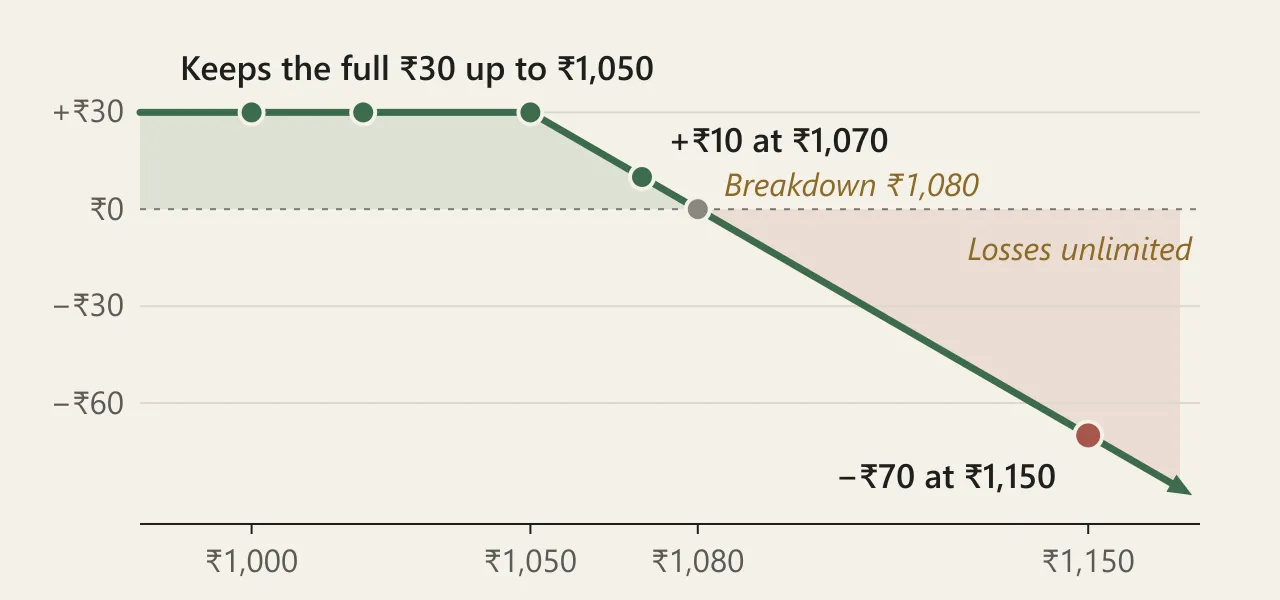
The 1050 call seller at expiry, per share. The six dots are the six scenarios. Profit is capped at the ₹30 premium. It starts shrinking above the ₹1,050 strike, hits zero at the ₹1,080 breakdown point, and beyond that the loss keeps growing.
What the six scenarios tell us
I think you can pretty much do the calculations yourself now that I’ve pointed out a few important scenarios. We can sum them up like this:
- If the underlying expires below my breakdown point (strike price + premium), I make a profit. (Scenarios 1, 2, 3 and 4)
- If the underlying expires at or below the strike price of the call I sold, I keep all the premium I received from the buyer. (Scenarios 1, 2 and 3)
- If the underlying expires above the strike price but not above the breakdown point, I still keep some share of my premium. (Scenario 4)
- If the underlying expires above my breakdown point, I make losses depending on where the underlying expires. There is no limit on the losses.
- I cannot profit more than the premium I receive, but I can lose more than it (unlimited loss).
If we generalise these points further, we can narrow them down to three general scenarios.
- Scenario A · At or below the strike: seller is profitable and keeps the full premium.
- Scenario B · Between strike and breakdown: seller is still profitable and keeps part of the premium.
- Scenario C · Above the breakdown point: seller makes losses, and the loss is unlimited.
Out of the three scenarios, the seller has a 66.67% chance of ending up profitable, while the buyer on the other end has only a 33.33% chance. This is, of course, keeping other factors constant.
- 66.67%: the call seller’s chance of ending up profitable
- 33.33%: the call buyer’s chance on the other end
The seller’s real enemy: tail risk
The main risk an option seller should keep an eye on is what we call tail risk. Tail risk is the chance that an unexpected and extreme investment loss will occur because of a rare market event.
We’ll talk about this in detail in other articles. For now, I hope you’ve understood the perspective of a call option seller.
So, we have learned that
- For every call buyer, there’s a call seller who thinks the opposite. If the buyer is bullish, the seller is bearish.
- The seller receives the premium, and is obliged to sell the underlying if the buyer exercises.
- The buyer’s breakeven point (strike price + premium) is the seller’s breakdown point.
- A call seller has limited profit and unlimited loss.
- Keeping other factors constant, the seller has the better probability of profit: 66.67% against the buyer’s 33.33%.
- The seller’s main risk to watch is tail risk, the rare, extreme market move that can brutally punish option sellers.
If you have any questions, feel free to leave them in the comments, and I’ll do my best to answer them.
Referral link. *The brokerage will not exceed the SEBI prescribed limit. Investment in the securities market are subject to market risks, read all the related documents carefully before investing. Zerodha, #153/154, 4th Cross, Dollars Colony, Opp. Clarence Public School, J.P Nagar 4th Phase, Bangalore - 560078, Karnataka, India. SEBI Registration no.: NSE & BSE INZ000031633, MCX INZ000038238. Broker member code: NSE 13906, BSE 6498, MCX 46025.
Get new lessons by email
One email when a new article is published, free. Unsubscribe any time. We only use your email to send the newsletter; see the privacy policy.