What Is a Derivative, Really?
The foundation beneath futures and options explained with a litre of milk.
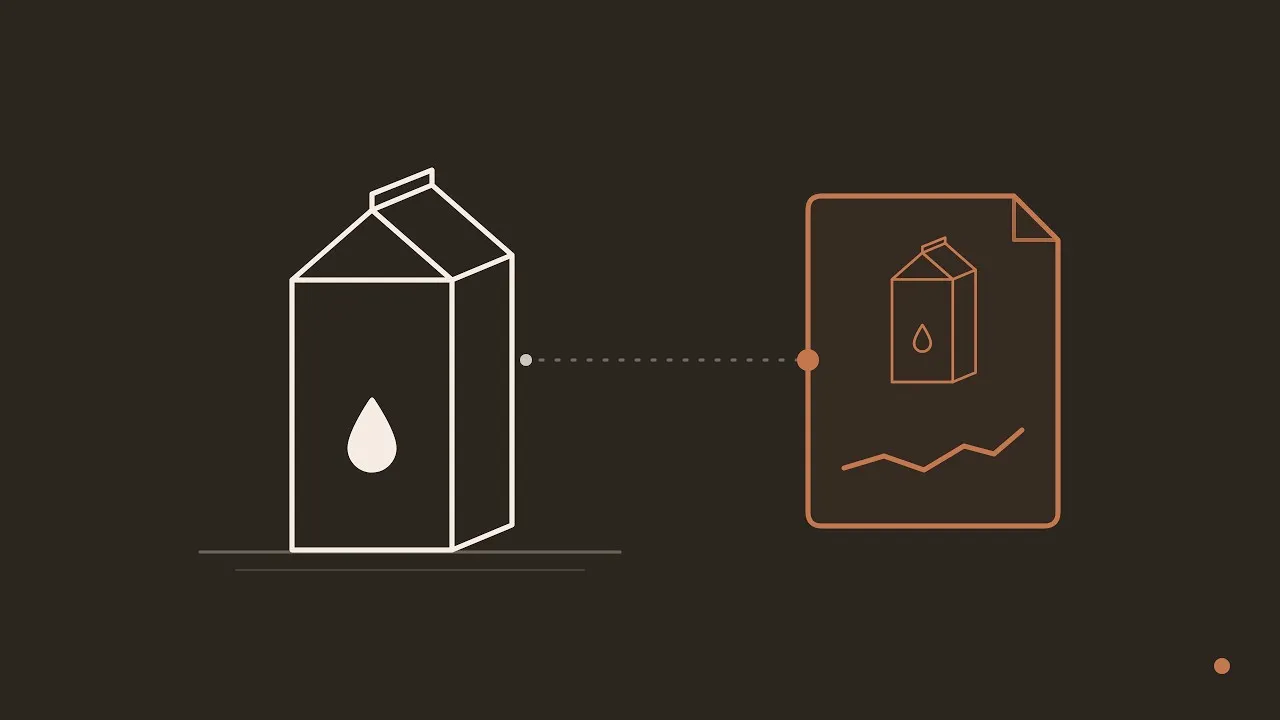 Watch the video: What Is a Derivative, Really?
Before we dive into the nuts and bolts of options, we first have to understand what a derivative is. A derivative is a contract — or a product — whose value is derived from the value of some other asset, known as the underlying.
The underlying could be a wide range of assets: metals such as gold, silver and copper; energy resources such as oil, coal and natural gas; agricultural products; and financial assets such as shares, bonds and foreign exchange.
An everyday example — milk and its products
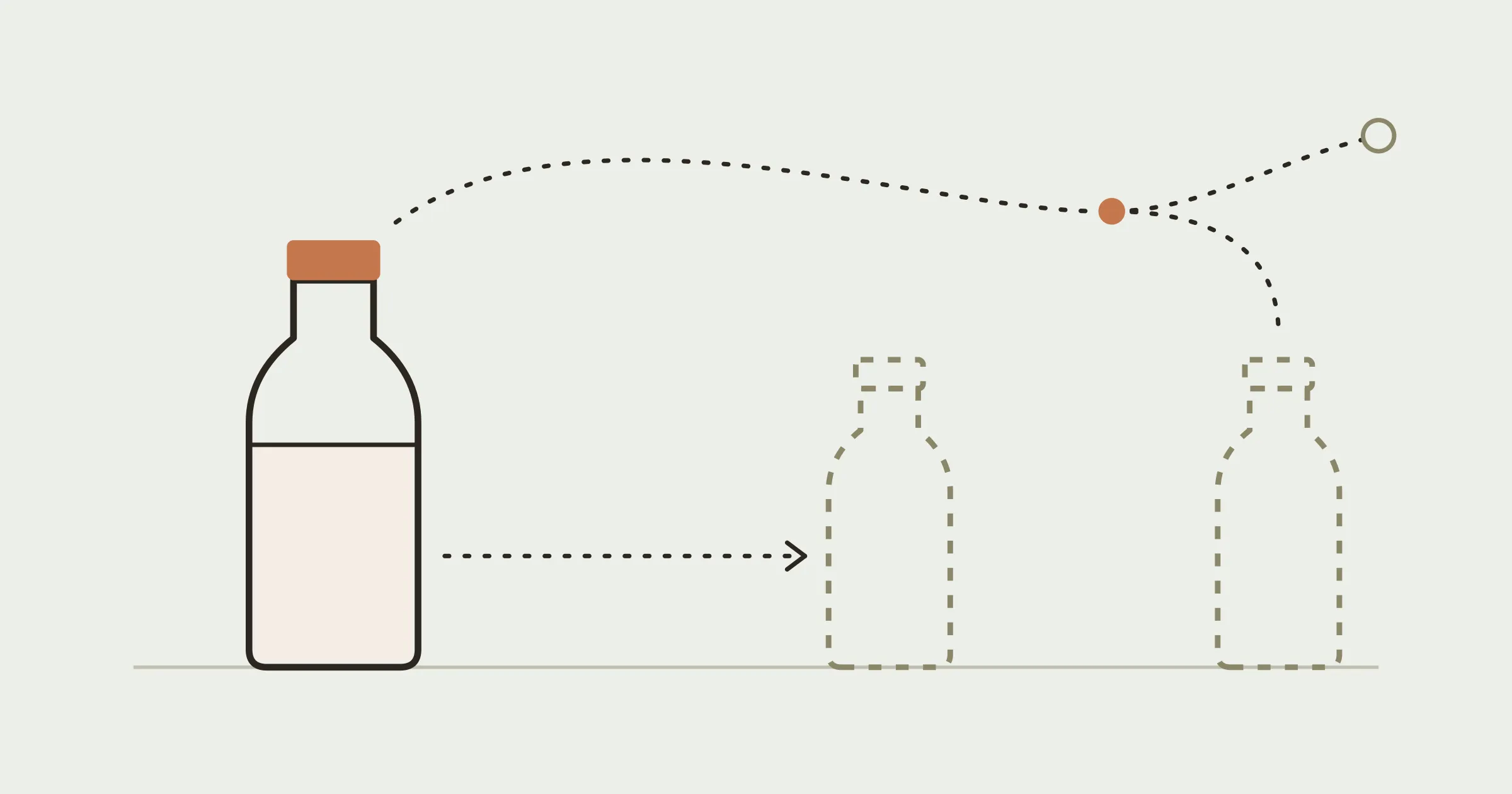
Suppose you have one litre of milk. For the sake of the example, let’s say it costs ₹50 a litre. From that same milk you can make dahi, butter, lassi, cheese, and so on. Now, if the cost of milk per litre goes up, the price of everything you make from that milk has to rise as well.
That’s the first link between a derivative and its underlying. Here, the products made from the milk — the dahi, the butter, the cheese — are the derivatives, and the milk is the underlying.
That’s the basic idea of a derivative you have to understand first.
A quick history
Derivatives go back several centuries. In earlier times, European traders signed contracts promising the future delivery of goods they had sold. In the 13th century, English Cistercian monasteries frequently sold their wool up to 20 years in advance to foreign merchants. Fast forward to 1848, when the Chicago Board of Trade began facilitating the trading of forward contracts on various commodities — and in 1983, the Chicago Board Options Exchange (CBOE) introduced options on stock indexes, with the S&P 100 and S&P 500 as the underlying. We’ve come a long way.
Over the last five decades this growth has been phenomenal, with many derivative contracts launched at exchanges across the world. Some of the drivers: increased fluctuations in underlying asset prices; greater integration of financial markets globally; the use of the latest communications technology, which has lowered transaction costs; and a better understanding, among market participants, of sophisticated risk-management tools.
Derivatives in India
In India, the first step towards derivative trading came under the chairmanship of Dr. L.C. Gupta. On 18 November 1996, SEBI set up a 24-member committee under him to develop the regulatory framework for derivatives trading. SEBI also set up a group in June 1998 under Professor J.R. Verma to recommend measures for risk containment in the derivatives market. In 1999, the Securities Contracts (Regulation) Act was amended to include derivatives within the definition of securities, and a framework was developed to govern derivative trading.
Exchange-traded derivatives formally began in June 2000, with SEBI permitting the NSE to introduce an equity-derivatives segment. Index options followed in 2001, options on individual stocks started in July 2001, and futures on individual stocks started in November 2001.
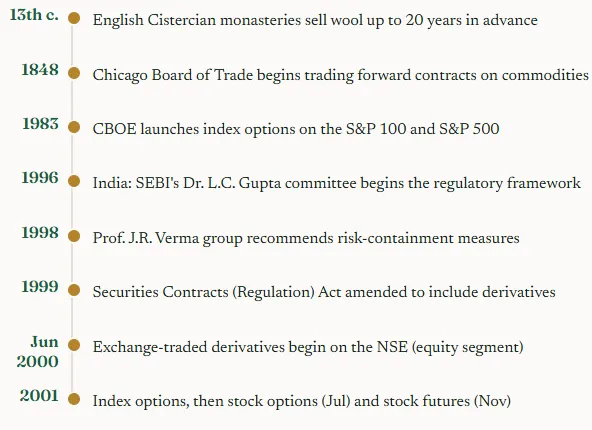
Quick (not complete) history of derivatives.
Forwards, futures, options and swaps
Before futures and options, there were forwards. A forward is simply a contractual agreement between two parties to buy or sell an underlying asset at a certain future date, at a price decided on the date of the contract. Both parties are committed and obliged to honour the transaction, regardless of the price of the underlying at the time of delivery. Because forwards are negotiated privately between two parties, they can be customised to those parties’ preferences — which is why they’re called over-the-counter, or OTC, contracts.
Then came futures. A future is similar to a forward, except the deal goes through an organised, regulated exchange rather than directly between the two parties. So you could say futures are exchange-traded forward contracts — regulated and standardised.
Then we have options, which we’ll be talking about a lot. An option is a contract that gives you a right, but not an obligation. Depending on the option you buy, you can buy or sell the underlying on or before a stated date, at a stated, predetermined price. The buyer of an option pays a premium and buys the right. The seller receives the premium and takes on the obligation to sell or buy the underlying if the buyer exercises that right.
There’s also the swap, which we won’t discuss much. We’ll mostly be focusing on futures and options.
Three players in the market
In the derivatives segment there are mainly three types of participants.
Hedgers
They face risk tied to the price of an underlying asset and use derivatives on that underlying to reduce it. Corporates, investing institutions and banks all use derivative products to hedge their exposure to market variables — fluctuations in interest rates, share values, bond prices, commodity prices, and so on.
Speculators / traders
Where most people fall. They try to predict future movements in the price of an underlying asset and take positions in derivative contracts based on that view. They often prefer derivatives over the underlying itself, because derivatives offer leverage, are less expensive to trade, and are easier and faster to execute in size.
Arbitrageurs
They profit by exploiting a price difference for the same product in two different markets. Say an asset trades at ₹100 in Market A and ₹102 in Market B — the arbitrageur buys in the cheaper market and sells in the dearer one. In theory it’s risk-free, provided there’s no cost to carry it out. But such chances are rare, especially for retail traders, and capturing them takes a very sophisticated quantitative model to find and exploit the inefficiency.
Why derivatives matter
We’re going to dive deep into options, but first we should understand why derivatives matter in the first place.
Price discovery
They improve price discovery, based on real supply-and-demand relationships and expectations.
Risk transfer
They let risk move from those exposed to it, with a low appetite for it, to participants with a higher appetite who are willing to speculate. For example, if I hold a ₹1 crore portfolio and want to take the risk off, I can go to the derivatives market and hedge it by buying a put option — and traders willing to take on that risk will sell those puts to me.
Organising speculation
They shift speculative activity from unorganised markets — forwards negotiated privately between two counterparties — into a regulated, standardised, organised space.
Stability
Risk-management mechanisms and surveillance of participants in that organised space bring stability to the financial system.
But know the risks
Before you go and trade the market, understand that derivatives carry higher risks.
Counterparty (default) risk
The risk that the other side defaults. This is lower today, since products are standardised — but it can still happen.
Price risk
Because derivatives are leveraged, a position moving against you can cause a huge loss on your capital — one you may not be able to afford.
Liquidity risk
If you trade an instrument without enough buyers or sellers, you may not be able to exit your position.
As a market participant, you should carefully consider whether such trading is suitable for you, based on these parameters. That’s why it’s important to read the risk disclosure document your broker gives you at the time of signing the agreement. Everyone should read that document before trading in the capital market — the cash segment — or the F&O segment of the exchanges.
Looking to start trading futures & options?
Referral link. *The brokerage will not exceed the SEBI prescribed limit. Investment in the securities market are subject to market risks, read all the related documents carefully before investing. Zerodha, #153/154, 4th Cross, Dollars Colony, Opp. Clarence Public School, J.P Nagar 4th Phase, Bangalore - 560078, Karnataka, India. SEBI Registration no.: NSE & BSE INZ000031633, MCX INZ000038238. Broker member code: NSE 13906, BSE 6498, MCX 46025.
Get new lessons by email
One email when a new article is published, free. Unsubscribe any time. We only use your email to send the newsletter; see the privacy policy.