Buying a Call Option
Limited risk and unlimited reward sounds like every new trader's dream. Here's what you're really getting into.
 Watch the video: Buying a Call Option
If you’re reading this, it means you’ve understood what derivatives are. If you haven’t fully understood what a derivative is, I’m currently making a series on options trading, arranged like a course so that you can learn in a systematic way. Kindly go back to the start of the series and read it closely. Otherwise, I’ll assume you understand it.
To fully understand options, and eventually trade them, it’s very important to know what you’re getting into. That’s what we’ll try to cover in this article.
The option buyer’s perspective
Let’s first try to understand the perspective of an option buyer. When you buy an option contract, you are simply buying the right to buy or sell an asset at a predetermined price after a certain period. But you are not obligated to buy or sell it. You have the right to buy or sell, but it’s up to you whether you use that right.
Since you are buying a contract, in this case the right to buy or sell an asset, there must be a price for that option contract. The price you pay to obtain the right to buy or sell an asset is called the premium. We’ll go into the details of that much later. For now, let’s understand the core definition of buying an option contract.
An example: stock ABC
Say stock ABC is trading at ₹2,000. As a trader, I speculate that in one month’s time the share price of ABC will head higher, and I want to buy 100 shares. In other words, I am bullish on the stock. So what I can do is either:
- Buy the 100 shares of ABC the traditional way, or
- Buy an option contract that gives me the right to buy 100 shares of the stock at ₹2,000 in one month’s time.
Let’s assume I take the second path and buy the option contract. To buy the contract, I have to pay what the contract is worth today, which is the premium. Let’s say the premium is ₹20.
So to fund this trade, and to obtain the right to buy the stock at ₹2,000 per share in one month’s time, I have to pay the counterparty, the seller (remember, I am the buyer). The seller receives the premium I paid.
| My trade: buying the ABC call | |
|---|---|
| Stock ABC today | ₹2,000 |
| Right to buy at (strike price) | ₹2,000 |
| Premium per share | ₹20 |
| Quantity | 100 shares |
| Expiry | One month |
| Premium paid to the seller | ₹2,000 |
Now that I’ve paid the premium to the seller, all that’s left is to wait a month and see how things work out. One of three things can happen:
- The share price of ABC moves up, say to ₹2,200.
- The share price of ABC falls, say to ₹1,400.
- The share price of ABC stays where it was, at ₹2,000.
Three ways it can go
Case 1 · ABC rises to ₹2,200
In this first case, the stock has moved in my favour. Who wouldn’t want the ability to buy a stock at a much cheaper price (₹2,000) than the current price (₹2,200)? So it would be wise for me to exercise my right to buy stock ABC at ₹2,000. Let’s calculate my profit or loss.
One would be quick to say it’s the current price of the stock minus the price I have the right to buy at: (₹2,200 − ₹2,000) × 100 shares = ₹20,000. Hold this thought; we’ll come back to it.
But now, recall the premium I paid when the trade happened. I paid ₹20 per share to the seller of the contract. Clearly, that ₹2,000 (₹20 × 100 shares) is my expense and must be included in the equation as well. So my profit and loss, excluding brokerage, taxes and other charges, would be:
Before we move on to the second case, I want to clarify a few things that are new here.
And one important thing: the option contract we’re talking about gives us the right to buy a stock at a predetermined price after a certain time. That makes it a call option, or a Call European (CE for short), to be precise. If you don’t understand what a European contract is, I highly suggest you read the previous part of this series.
Case 2 · ABC falls to ₹1,400
If I have the right to buy the stock at ₹2,000 while it’s trading at ₹1,400, why on earth would I exercise that right and buy it at ₹2,000? Doing nothing, not exercising, is the best option, and that’s what any sane person would do here.
Now imagine I had taken this trade the traditional way. I’d be sitting on a loss of ₹60,000: (₹1,400 − ₹2,000) × 100 shares.
Since I chose to take this trade through an option, my loss is only ₹2,000, the premium I paid. That’s because I didn’t exercise the right to buy the stock at ₹2,000 just to sell it back to the market at ₹1,400.
So even if the stock price falls to zero, I cannot lose more than the premium I’ve paid to the seller.
Case 3 · ABC stays at ₹2,000
Once again, exercising my right to buy stock ABC at ₹2,000 when it’s trading at ₹2,000 doesn’t make sense. In fact, the reason I bought the option was that I was speculating the share price would shoot up in the coming month, and it clearly didn’t. Since exercising here makes no sense, I’d be sitting with a loss of ₹2,000, the premium I paid as a buyer to the seller of the contract.
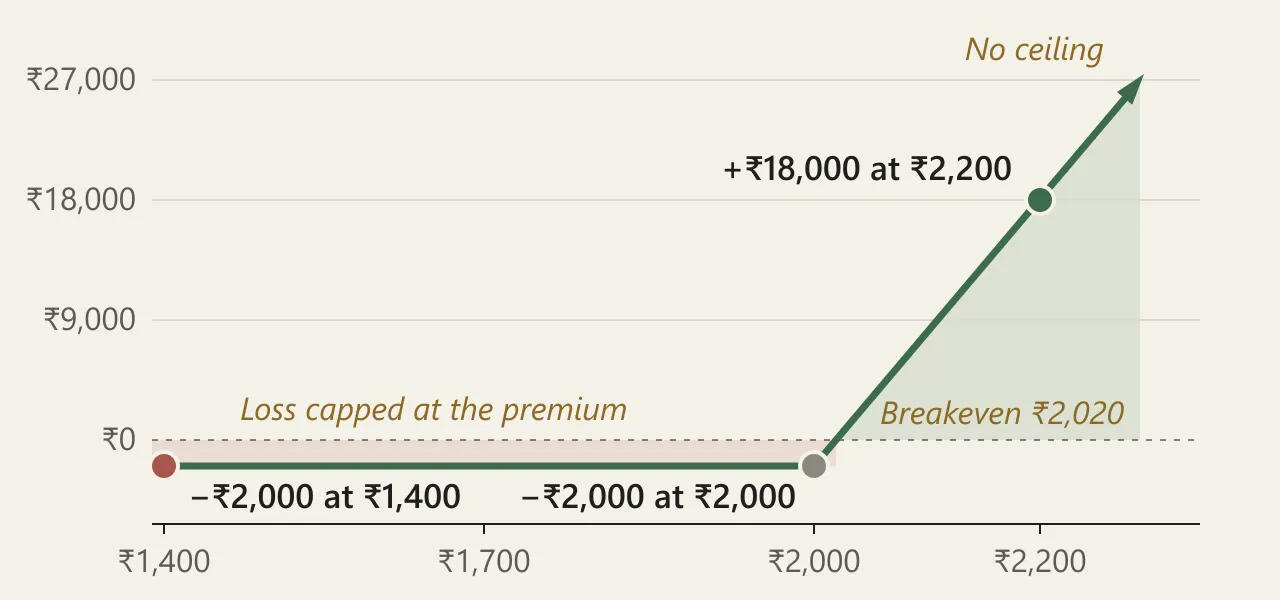
The ABC call at expiry. The three dots are the three cases above. Below ₹2,000 the loss never goes beyond the ₹2,000 premium, however far the stock falls. The trade breaks even at ₹2,020 (strike plus premium), and above that the profit keeps growing.
Limited risk, unlimited reward
Look at the first case, where ABC shot up to ₹2,200. Clearly we made money on that trade, and if the stock had gone even higher by the end of the month, we’d have made even more. There’s no ceiling on how much we can make. In other words, buying an option has unlimited reward.
And looking at the second case, no matter how far the stock price falls, as an option buyer I cannot lose more than the premium I paid to the seller. So buying an option has limited risk.
The catch: the odds
It sounds great, doesn’t it? Limited risk with unlimited reward potential is what every new trader wants. So does a gambler.
Out of the three scenarios I’ve described, I’m profitable in only 1 out of 3. Keeping the other factors that affect an option’s price constant, that’s my chance of winning.
- 33.33%: the option buyer’s probability of profit in our example
- 66.67%: the option seller’s probability of profit on the other side
And in the real world, the other factors we’ve kept constant for the sake of simplicity play a huge role in determining an option’s premium, and they can reduce an option buyer’s chance of profit even further. While the buyer’s chance of making a profit is this thin, the seller on the other side enjoys a higher probability of profit.
One more term: expiry
Before we sum up, there’s one more very important term: expiry. When I bought the option that gives me the right, but not the obligation, to buy stock ABC at a strike price of ₹2,000, I could exercise that right only after a month. The final day a derivative contract remains valid, and the buyer can exercise their right, is called the expiry date.
So, we have learned that
- Buying an option gives you the right, but not the obligation, to buy or sell an asset at a predetermined price after a certain time.
- Buying a call option gives you the right, but not the obligation, to buy an asset at a predetermined price after a certain time.
- An option buyer pays a premium to the option seller, who is on the other side of the trade.
- As an option buyer, your reward is unlimited while your risk is limited.
- An option buyer’s probability of profit is lower than the seller’s.
- The strike price (or exercise price) is the fixed, predetermined price at which an option buyer has the right to buy or sell the underlying asset, regardless of where the market price moves.
- Expiry (or expiration) is the final date and time a derivative contract is valid before it stops existing and trading on the exchange.
That’s it for this article.
Referral link. *The brokerage will not exceed the SEBI prescribed limit. Investment in the securities market are subject to market risks, read all the related documents carefully before investing. Zerodha, #153/154, 4th Cross, Dollars Colony, Opp. Clarence Public School, J.P Nagar 4th Phase, Bangalore - 560078, Karnataka, India. SEBI Registration no.: NSE & BSE INZ000031633, MCX INZ000038238. Broker member code: NSE 13906, BSE 6498, MCX 46025.
Get new lessons by email
One email when a new article is published, free. Unsubscribe any time. We only use your email to send the newsletter; see the privacy policy.