Seven years to learn to do less
Every improvement was something I removed.
This is my seventh year of trading.
I spent the first two of them making art and calling it analysis.
The drawing years
Like most people who start, I began discretionary. I believed in the support and resistance lines I drew on the chart, because the price kept bouncing off them or breaking through, and that felt like proof. So I went deeper. I studied the patterns. Head and shoulders. Flags. Pennants. Triangles. I put real hours into learning to draw them well.
I used to argue with my trader friends about it. I’d tell them their lines were wrong, that they’d drawn the ascending triangle incorrectly, that mine was the right one.
It took me until my third year to understand why those arguments were pointless. There is no correct way to draw an ascending triangle. There is no right answer. It’s all subjective. I wasn’t objectifying anything. I was drawing wishful thinking on a chart and mistaking the neatness of the drawing for the truth of it.
That was the first thing I had to remove: the belief that the picture meant something because I’d drawn it carefully.
The fusion years
I didn’t know systematic trading existed yet. I just knew the drawing wasn’t working, and I wanted a right way to look at the market. So I built one.
I called it fusion. Fundamentals to screen for good stocks, the quantitative side, the real numbers, and technicals to time the entries and exits. This was my first real step toward rule-based trading. It felt like an upgrade, because it was. I’d added rigor.
Then I watched fundamentally bad stocks rip upward with no explanation, month after month, while the earnings report or the turnaround news that would have justified the move showed up much later, if at all.
That taught me what fundamental analysis is actually for. It’s a superb tool for understanding a business. If you’re the one running the company, corporate finance, the income statement, the balance sheet, the cash flow, there’s nothing better. If I owned an enterprise, that’s exactly where I’d put my effort. But I don’t own the companies I trade. I’m hopping onto a trend and getting off it. For that job, fundamentals lagged. They made my whole system slow. The right tool for the owner is the wrong tool for the trader.
So I removed it. A whole layer I’d been proud of building, gone.
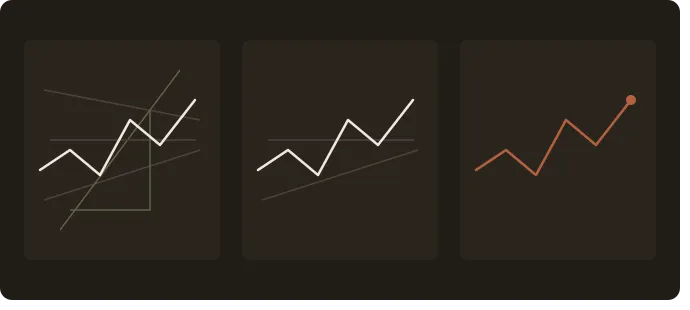
Seven years of removing things. This is what was left.
What was left
What remained when I stopped adding things was just the price. Where it’s heading, and whether I’m on the right side of it.
Today I run a systematic portfolio built purely on that. Momentum. Trend following. Cutting losers aggressively. It’s the direct descendant of the fusion strategy, except with the heavier half removed. Every version of my trading got better at exactly one thing: taking something out.
That’s the pattern I couldn’t see while I was living it. I thought I was getting more sophisticated. I was actually getting simpler. The drawing years, I removed the belief in my own lines. The fusion years, I removed the fundamentals I didn’t need. What was left each time worked better than what I took away.
It took me seven years to find the click. For me, systematic trading is the thing that gets the best out of me. That won’t be true for everyone, and I won’t pretend it is. But the deeper lesson underneath it is one I’d stand behind for anyone: as I got older, in age and in trading, I learned that simplicity beats complexity. Almost every time.
I hope this is useful to you. I hope it cuts your learning curve, and that you end up twice as good as me in your seventh year.
Nothing here is advice. I’m not your SEBI-registered advisor. This is how I think, not what you should do.